20/10/2026 20:58
Is the Mechanic on the Way? Telegram Live Location for Cambodian Mobile Bicycle Repair Businesses

A customer sees your bicycle repair demonstration on Telegram and asks whether you can visit their shop. You agree on a meeting place, but the next messages become a stream of questions: Have you left? Which entrance are you approaching? Should someone wait outside? For a Cambodian mobile repair business, promotion works better when the conversation after the post is also clear. Telegram live location can help coordinate a confirmed visit. It should sit within a workflow that defines the repair request, protects personal movements and distinguishes an enquiry from an appointment. This guide explains that workflow, including where SMM panel records belong and what they cannot prove.
1. Give the public post one clear job
Start with a post that helps someone decide whether to enquire. Show a repair you actually offer, state your service area and explain what information you need before accepting a visit. A useful bicycle repair post might ask for a photograph of the problem, the bicycle type and the customer's general neighbourhood. Do not ask people to publish their home address or movements beneath a promotional post.
For a hypothetical Phnom Penh mobile mechanic, the message could explain that visits depend on the problem, available parts and the day's route. Invite readers to send a private enquiry before expecting a departure update. Use Khmer wording that your intended customers understand, with another language where useful. The important promise is a clear assessment process. Advertising immediate arrival when you have not checked capacity creates confusion that a moving map pin cannot resolve.
2. Choose between a fixed pin and live location
A fixed location answers where people should meet. Live location helps someone follow the position of the person travelling. If the customer will wait at a shop entrance, a fixed pin plus a landmark description may be enough. Consider live sharing when the mechanic is approaching an unfamiliar lane or when both people need help finding each other.
Telegram's official live-location announcement describes time-limited sharing and the ability to stop it. Its later update documents extending an active share and sharing until manually stopped. For a single service visit, choose a limited duration suited to the journey. Availability of an indefinite option is not a reason to use it routinely. Make the destination explicit in a separate message so the customer's meeting point is not confused with the mechanic's changing position.
3. Confirm the appointment before showing movement
Use a short confirmation exchange before departure. Agree on the bicycle problem, meeting point, contact person and arrival window. Explain whether the visit is for inspection or for an already agreed repair. Where relevant, clarify how travel charges, parts and additional work will be discussed. A photograph can help preparation, but it does not necessarily establish the full repair required.
In a hypothetical booking, a customer reports a slipping chain and asks for a visit behind their shop. The mechanic requests a clearer photograph, checks whether the required tools are packed and agrees to inspect the bicycle during an afternoon window. Only after the customer accepts does the mechanic offer temporary location sharing. That sequence prevents a casual question from turning into an assumed booking and gives both parties a written reference if plans change.
4. Start sharing in the intended conversation
Telegram documents starting live location from the attachment menu in a private chat or group: choose Location, then the live-location sharing option. For this workflow, open the confirmed customer's private conversation, check the recipient and select an appropriate duration. Test the process with a colleague before making it part of a public service promise.
Add a brief message explaining whose position is being shared and why: the mechanic is travelling to the agreed meeting point. Ask the customer to confirm that the map opens. Treat this as a practical coordination check, not proof that the appointment is proceeding successfully. Before setting off, check the phone's battery, connection and location settings. Make any changes while safely stopped; the customer should not expect a rider to type continuous updates during the journey.
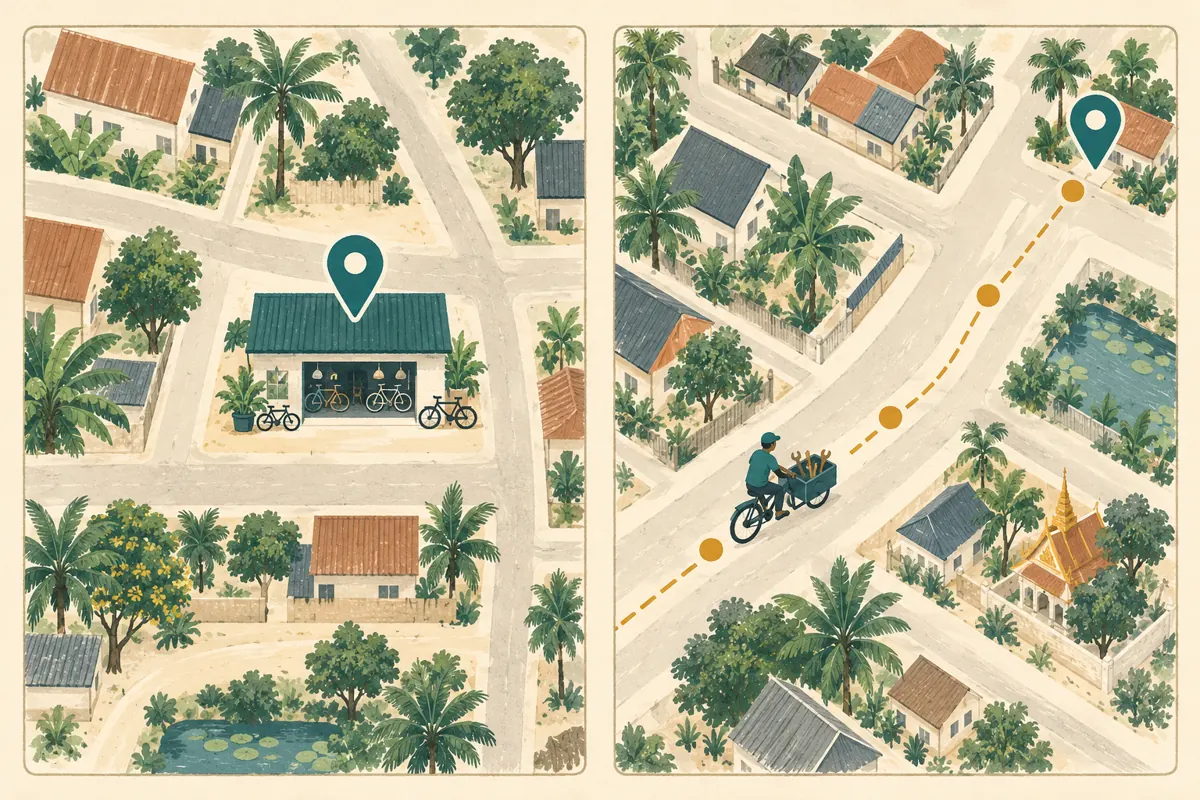
5. Keep the audience small and the purpose specific
Share only with people who need to coordinate that appointment. A customer does not need to see the mechanic's whole working day, earlier stops or journey home. Likewise, the mechanic rarely needs a customer to broadcast their movements when a fixed meeting point would do. Offer a landmark description or ordinary message exchange when someone prefers not to use live location.
If a group is necessary because a shop assistant will receive the mechanic, check its membership before sharing. Explain the purpose to everyone involved. Do not turn location screenshots into promotional proof or reuse a customer's address in a service demonstration. Private coordination can reveal information unrelated to bicycle repair. Keep promotional materials focused on the work itself, with permission for any identifiable people or premises that appear.
6. Use an arrival window and a fallback message
A position on a map is not a promise of arrival at a particular minute. Build your customer message around an arrival window you can reasonably manage. If an earlier repair takes longer or the meeting point changes, communicate the revised plan explicitly. Do not assume the customer will infer a delay, cancellation or detour from the map.
Agree on a fallback before departure: if the location appears stale or the map cannot be opened, the customer can send a message and the mechanic will reply when safely stopped. A short landmark description can resolve the final approach, especially where several entrances face different lanes. Ask which entrance is usable and where the bicycle will be waiting. Avoid repeatedly asking the customer to walk towards a moving marker; choose a stable meeting place instead.
7. Close the visit and stop sharing
When you meet, confirm that you have found the right customer and bicycle. Stop live sharing once its coordination purpose is finished. If the visit is cancelled, end the share and acknowledge the cancellation in the conversation. Stopping location updates should be a deliberate closing action, rather than something staff hope the timer will eventually handle.
Then record the business outcome separately: inspection completed, repair accepted, parts required, rescheduled or cancelled. Keep only the details needed for the job and follow-up. Do not describe stopping a share as erasing information someone may already have seen or captured. If a colleague takes over the next visit, send a fresh appointment handover with the customer's agreement. An earlier location share should not become an informal substitute for dispatch instructions.

8. Give SMM panel services a separate decision
The supplied moha-smm.com catalogue includes the exact public service name Telegram Post Views ~ Max Unlimited ~ 10M/Days ~ INSTANT. The title identifies a post-view offering, but the supplied description is empty. Its quantity and speed wording is catalogue language, not independently verified performance. Nothing in that information establishes Cambodian viewers, genuine repair interest, booked visits or an official relationship with Telegram.
For this workflow, that service does not solve appointment confirmation or live-location coordination. If your actual problem is unanswered enquiries or missed meetings, improve those steps before considering any panel spending. If a panel order already exists, keep its target post, order reference and reported delivery in a separate record. Purchased engagement is not evidence of genuine interest, sales, ad delivery or Cambodian users, and should never be presented as proof that local customers trust the mechanic.
9. Review the promotion through real conversations
Telegram's Channels FAQ explains that post view totals include forwarded copies and are approximate. They are therefore unsuitable as a count of unique local prospects. Review the customer journey through information your business actually records: relevant enquiries, accepted visits, completed work and recurring points of confusion. Ask customers which post brought them to the conversation, while allowing for people who cannot remember.
A hypothetical weekly review might reveal that customers understand the repair demonstration but repeatedly ask whether the mechanic covers their area. That suggests improving the service-area wording. If confirmed customers struggle at the final entrance, improve meeting instructions. If enquiries arrive while nobody is available to answer, adjust staffing or the advertised response expectation. None of these conclusions requires claiming that a higher view counter caused more repairs or that live location improved sales.
10. Correct common mistakes before the next promotion
The first mistake is offering tracking before confirming the job. Correct it by requiring a clear acceptance message. The second is sharing with a broad customer group because it is convenient. Correct it by checking the audience for each appointment. The third is leaving sharing active after a visit. Add a stop-sharing check to the same routine used to close the repair record.
Another mistake is treating the map as the entire customer update. Preserve a written meeting point and send an explicit message when plans change. Finally, avoid promoting the feature as a guarantee of punctuality or safety. Describe it modestly as an optional way to coordinate an agreed visit. Test the complete journey with a colleague: enquiry, confirmation, map opening, changed meeting instructions and closure. Fix confusing steps before making the workflow part of your regular promotion.

Frequently asked questions
Should customers share their live location with the mechanic too?
Only when it helps and they are comfortable doing so. For someone waiting at a shop or home, a fixed meeting point and entrance description will often be sufficient. Do not make continuous tracking a condition of receiving a quotation. If the customer is moving, agree on a stable meeting place first so neither person has to chase the other's marker.
What should we do if the live location appears frozen?
Use the fallback conversation and confirm the last understood meeting point. The mechanic can check the connection, location settings and active share when safely stopped. Do not assume a stationary marker means the mechanic has cancelled or arrived. If the feature remains unhelpful, continue with landmark directions and an updated arrival window instead of repeatedly asking the customer to refresh.
Can we use indefinite sharing for every working day?
Telegram supports sharing until it is manually stopped, but a routine customer visit generally needs a narrower window. Indefinite sharing makes it easier to expose movements after the appointment. If a business has a separate internal coordination need, define who can see the location, why it is needed and when it ends. Do not silently reuse customer-facing sharing for that purpose.
Does live location confirm that a repair booking was accepted?
No. Write the acceptance separately, including the meeting point and agreed timing. A map only provides location information; it does not establish the repair scope, price approval, parts availability or customer consent to additional work. Keeping those decisions in ordinary messages also helps another staff member understand the appointment without interpreting a trail of map updates.
Should we buy post views to test demand for mobile repairs?
Purchased views cannot establish demand from Cambodian bicycle owners. Test the offer through relevant enquiries and appointments that your team can verify, and record the questions people ask. The supplied post-view service description provides no evidence of local targeting or buyer intent. Use operational records to decide whether to expand a service area, change the repair offer or improve appointment handling.
Explore the current service catalogue, create an account, or ask a specific question through support tickets.
- Telegram: Live Locations, Media Player and Languages
- Telegram: My Profile, Recommended Channels and 15 More Features — Share Location Indefinitely
- Telegram Channels FAQ — What Does the Eye Icon Mean?
Prepared with AI assistance. Illustrations explain the workflow and do not represent customer results.